
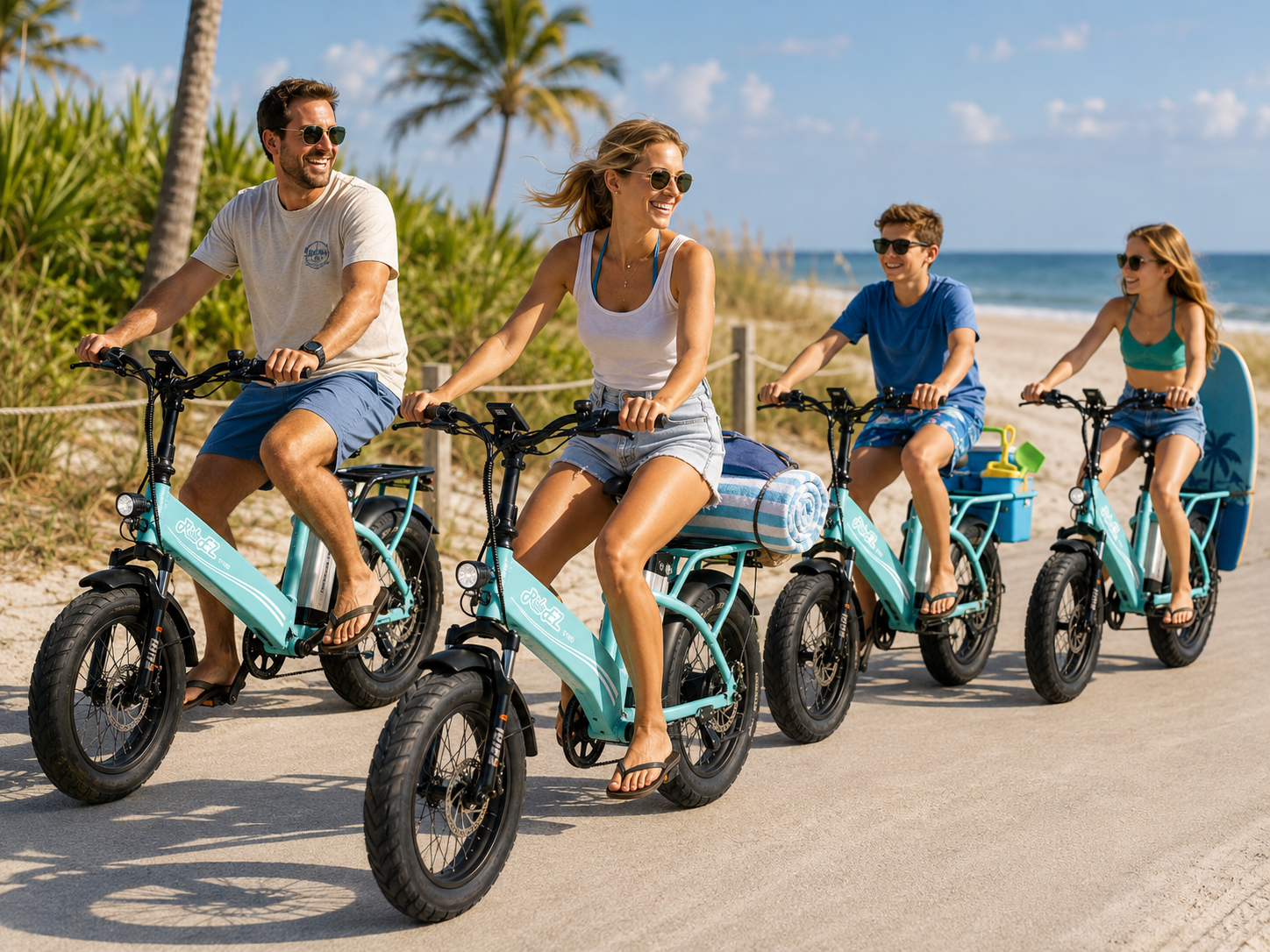
For vacation retailers, eBikes can be more than a product to sell.
They can also become a rental asset.
That is one of the advantages of the Ride E-Z dealer program. A dealer or vacation retailer can sell Ride E-Z eBikes through the normal dealer model, while also keeping a small fleet available for rentals.
That gives the business more than one way to make money from the same product category. Additionally, this article uses conservative numbers in every calculation and some of the variables might improve meaningfully for the buyer.
| Revenue Opportunity | What It Means |
|---|---|
| Dealer sales | Sell Ride E-Z eBikes to customers who are ready to buy. |
| Rental income | Rent eBikes to guests, visitors, campers, resort customers, and vacation renters. |
| Demo-to-order sales | Let customers ride first, then order their own color, accessories, or setup. |
For many vacation businesses, that matters because customers may not always be ready to buy an eBike on the spot.
But they may be very willing to rent one for a day, a weekend, or a vacation stay.
After riding one, some customers may later become buyers.
The simple idea is this:
Rent the bike. Let the customer experience it. Then give them a reason to buy one.
The Rental Opportunity
Vacation markets are built around experiences.
Customers already rent kayaks, paddleboards, golf carts, beach chairs, scooters, boats, bikes, and other outdoor equipment because they want to enjoy the area without making a large purchase.
eBikes fit naturally into that model.
They are fun, easy to use, and helpful in places where customers want to explore without driving everywhere.
eBikes can be especially useful in:
| Vacation Market | Why eBikes Fit |
|---|---|
| Beach towns | Visitors want easy local transportation without moving the car. |
| Campgrounds | Guests need a simple way to move around the property and nearby areas. |
| RV resorts | eBikes are easier than using a truck or RV for every short trip. |
| Lake communities | Riders can explore restaurants, shops, docks, and trails. |
| Marinas | Boaters can get around town after docking. |
| Golf communities | Residents and visitors want quiet, easy local transportation. |
| Resort destinations | Operators can offer a premium guest experience. |
| Downtown tourist areas | Visitors can cover more ground in less time. |
The key question for the retailer is simple:
How many rental days does it take for the bike to help pay for itself?
Vacation Markets Are Already Renting eBikes
Ride E-Z dealers do not need to invent the idea of vacation eBike rentals.
It is already happening.
Public rental examples show that vacation markets are already charging by the hour, by the day, and by the week.
For example, one Myrtle Beach rental operator publicly lists eBike rental rates up to $85 for 24 hours. A Panama City Beach / 30A operator publicly lists eBike rentals around $75 per day and $300 per week. Hilton Head has eBike rentals available, but some areas restrict where electric bikes can be used, which shows why local rules and ride-zone control matter.
| Market Example | Published eBike Rental Example | What It Shows |
|---|---|---|
| Myrtle Beach | Up to $85 for 24 hours | Beach customers already pay for eBike access. |
| Panama City Beach / 30A | Around $75 per day / $300 per week | Daily and weekly vacation pricing already exists. |
| Hilton Head | eBike rentals available, with restricted areas | Local rules and fleet control matter. |
The point is not that every Ride E-Z dealer should charge the same price.
The point is that vacation eBike rentals are already a real product.
Each dealer should look at local rates, season length, competition, delivery costs, insurance, and customer demand before setting final pricing.
Start With a Conservative Model
Rental demand is not the same every month.
A beach town, lake community, campground, resort, or mountain destination may have a busy season, a shoulder season, and an off season.
That is why eBike rental returns should be modeled conservatively.
Here is a simple example for one bike:
| Season | Months | Rental Days Per Month | Total Rental Days |
|---|---|---|---|
| Peak season | 3 months | 12 days | 36 days |
| Shoulder season | 4 months | 6 days | 24 days |
| Off season | 5 months | 2 days | 10 days |
| Annual total | 12 months | — | 70 days |
This model assumes one bike is rented only 70 days per year.
That is less than 20% of the calendar year.
This leaves room for slow periods, weather, maintenance, staffing limits, and conservative demand assumptions.
Simple Model Assumptions
The example below uses a small 5-bike rental fleet.
These numbers are only for planning. Each dealer should adjust the assumptions for their local market.
| Model Input | Example Assumption |
|---|---|
| Fleet size | 5 bikes |
| Bike cost | $2,000 per bike |
| Roamr / IoT hardware | $100 per bike |
| Total equipment cost per bike | $2,100 |
| Total fleet equipment cost | $10,500 |
| Annual rental days per bike | 70 days |
| Variable cost reserve | 30% of rental revenue |
| Insurance / risk reserve | $100 per bike per month |
| Roamr / IoT operating reserve | $50 per bike per month |
| Maintenance reserve | $350 per bike per year |
| Custom order gross profit example | $300 per bike order |
This is not a final Ride E-Z rental price.
It is a simple planning model.
What One Bike Could Produce
Using 70 rental days per year, here is what gross rental revenue could look like at different daily rental rates.
| Daily Rental Rate | Annual Rental Days | Gross Revenue Per Bike |
|---|---|---|
| $50/day | 70 days | $3,500 |
| $75/day | 70 days | $5,250 |
| $85/day | 70 days | $5,950 |
This is top-line rental revenue only.
It is before insurance, maintenance, labor, payment fees, cleaning, taxes, financing, charging, storage, delivery, and overhead.
Even at conservative usage, the revenue potential can be meaningful.
The bike is not just sitting on the floor waiting to be sold.
It can be working.
What a 5-Bike Fleet Could Produce
A vacation retailer does not need to start with a large fleet.
A small 5-bike fleet can be enough to test demand.
| Scenario | Daily Rental Rate | Rental Days Per Bike | Fleet Size | Gross Annual Rental Revenue |
|---|---|---|---|---|
| Conservative | $50/day | 70 | 5 | $17,500 |
| Base case | $75/day | 70 | 5 | $26,250 |
| Higher local market | $85/day | 70 | 5 | $29,750 |
This is why eBike rentals can make sense for vacation-focused businesses.
A small fleet can create rental income without requiring the retailer to operate like a large rental company from day one.
Monthly Rental Days by Season
This example assumes the bikes rent more often during peak vacation months and less often during slower months.
| Jan | Feb | Mar | Apr | May | Jun | Jul | Aug | Sep | Oct | Nov | Dec | Annual | |
| Rental days per bike | 2 | 2 | 6 | 6 | 6 | 12 | 12 | 12 | 6 | 2 | 2 | 2 | 70 |
Monthly Gross Revenue Example
Here is a simple monthly revenue view for a 5-bike fleet.
This uses the same conservative seasonal model: 70 rental days per bike per year.
| Q1 | Q2 | Q3 | Q4 | |
| Rental days per bike | 10 | 24 | 30 | 6 |
| Fleet rental days | 50 | 120 | 150 | 30 |
| $50/day | $2,500 | $6,000 | $7,500 | $1,500 |
| $75/day | $3,750 | $9,000 | $11,250 | $2,250 |
| $85/day | $4,250 | $10,200 | $12,750 | $2,550 |
This is not a final Ride E-Z rental price.
It is a planning example.
Each dealer should build pricing around the local market.
Expense Reserves Matter
Top-line revenue is not profit.
A smart rental operator should reserve money for insurance, maintenance, payment fees, customer support, cleaning, storage, charging, and fleet control.
For planning purposes, a dealer may want to include conservative reserves like this:
| Cost Item | Example Planning Reserve |
|---|---|
| Variable cost reserve | 30% of rental revenue |
| Insurance / risk reserve | $100 per bike per month |
| Roamr / IoT fleet-control service | $50 per bike per month |
| Roamr / IoT hardware | About $100 per bike one time |
| Maintenance reserve | $350 per bike per year |
Even with UL-approved systems, operators should still carry proper insurance and use proper waivers.
UL approval helps with battery and electrical safety confidence, but it does not replace rental-business insurance, safety rules, age rules, helmet rules, local riding rules, or customer agreements.
Monthly Cash Flow Example at $75 Per Day
This view is closer to an Excel cash-flow model.
It shows revenue, reserves, and estimated cash flow by month for a 5-bike fleet at an example $75 daily rental rate.
| Q1 | Q2 | Q3 | Q4 | Total | |
| Gross rental revenue | 3,750 | 9,000 | 11,250 | 2,250 | 26,250 |
| Less 30% variable reserve | 1,125 | 2,700 | 3,375 | 675 | 7,875 |
| Less insurance / risk reserve | 1,500 | 1,500 | 1,500 | 1,500 | 6,000 |
| Less Roamr / IoT operating reserve | 750 | 750 | 750 | 750 | 3,000 |
| Less maintenance reserve | 438 | 438 | 438 | 438 | 1,752 |
| Estimated cash flow before tax, financing, rent, and overhead | 63 | 3,612 | 5,187 | 1,113 | 7,623 |

Leave a comment
This site is protected by hCaptcha and the hCaptcha Privacy Policy and Terms of Service apply.