
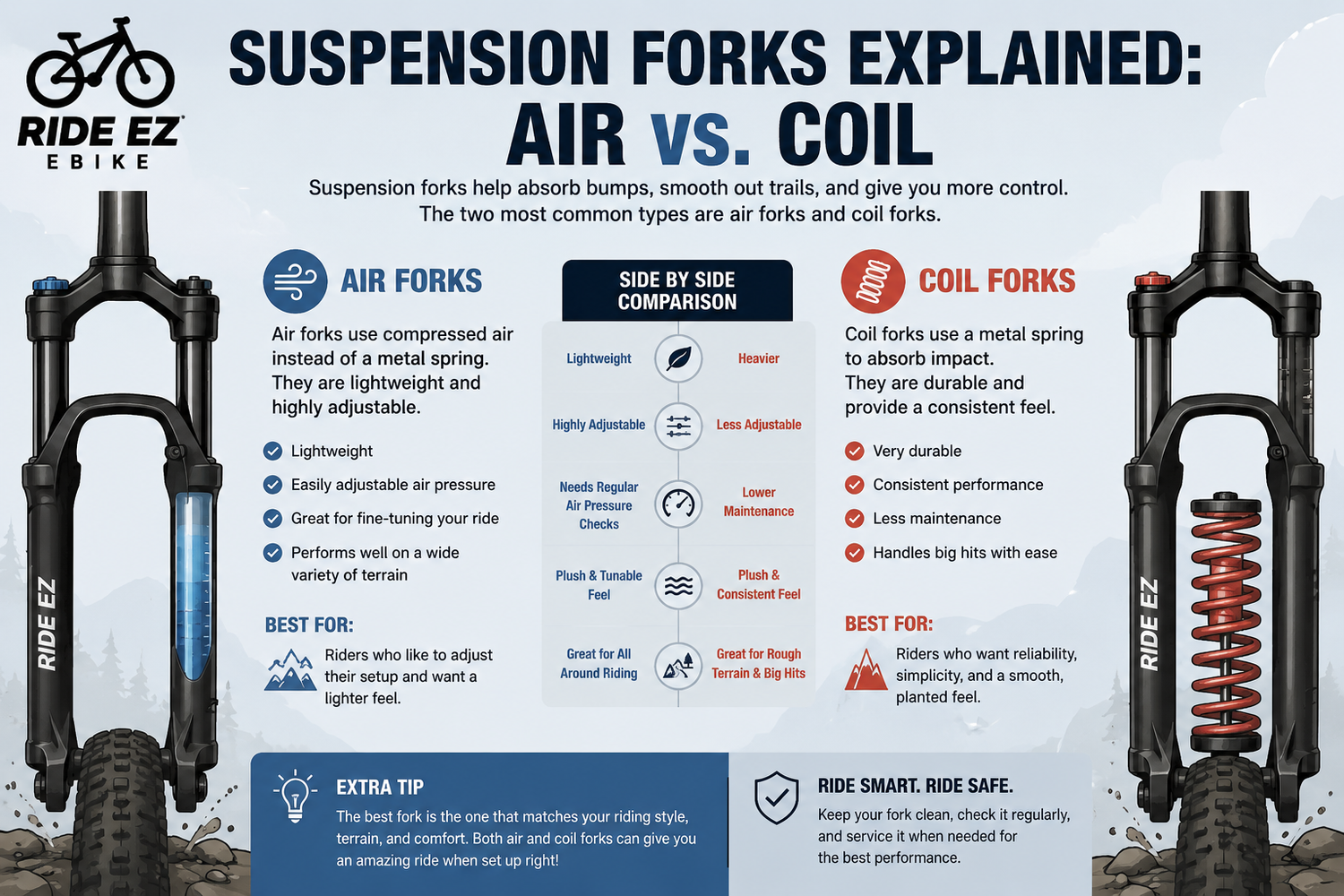
A suspension fork is one of the most important comfort and control features on a bike or eBike. It sits at the front of the bike and helps absorb bumps, potholes, gravel, roots, and uneven ground.
When shopping for a bike, replacement fork, or upgraded suspension, you will often see two common types: air suspension forks and coil suspension forks. Both are designed to make the ride smoother, but they work a little differently.
Understanding the difference can help you choose the right fork for your riding style, comfort needs, terrain, and budget.
What Does a Suspension Fork Do?
A suspension fork helps the front wheel move up and down when it hits bumps. Instead of the full impact going directly into the rider’s hands, arms, shoulders, and frame, the fork compresses and absorbs some of that force.
This can make riding more comfortable and controlled, especially on rough roads, trails, gravel paths, campgrounds, and uneven pavement.
For eBikes, suspension can be especially helpful because eBikes are often heavier than standard bicycles and may be used for commuting, recreation, camping, or everyday riding.
What Is a Coil Suspension Fork?
A coil suspension fork uses a metal spring inside the fork to absorb impact. When the front wheel hits a bump, the spring compresses. After the bump, the spring rebounds and returns the fork to its normal position.
Coil forks are common because they are simple, durable, and dependable.
Benefits of a Coil Fork
Coil suspension forks are often a good choice for riders who want a reliable and easy-to-use setup. They usually require less adjustment than air forks and can provide a smooth, consistent feel.
A coil fork may be a good choice for:
- Everyday riding
- Recreational riding
- Riders who want a simple setup
- Riders who prefer durability
- Budget-friendly bikes
- Casual trails, gravel paths, and neighborhood riding
Because the spring is mechanical, coil forks can be straightforward and dependable for many riders.
Things to Know About Coil Forks
The main limitation of a coil fork is adjustability. The spring rate is usually set by the spring inside the fork. Some coil forks include preload adjustment, which can slightly change how firm the fork feels, but they may not offer the same level of fine-tuning as an air fork.
A coil fork may also be heavier than an air fork, depending on the model.
What Is an Air Suspension Fork?
An air suspension fork uses pressurized air instead of a metal coil spring. Air inside the fork acts like the spring. Riders or technicians can adjust the air pressure to change how the fork feels.
This makes air forks more adjustable for different rider weights, riding styles, and terrain.
Benefits of an Air Fork
Air forks are popular with riders who want more tuning options. By adding or removing air pressure, the fork can be made softer or firmer.
An air fork may be a good choice for:
- Riders who want a lighter fork
- Riders who want more adjustability
- Trail riding
- Sportier riding
- Different rider weights
- Riders who want a more customized feel
Air forks can be especially useful when a rider wants the fork to match their weight and riding style more closely.
Things to Know About Air Forks
Air forks can require more setup and maintenance than basic coil forks. To get the best performance, the air pressure should be adjusted correctly. Riders may need a shock pump to make these adjustments.
If the air pressure is too low, the fork may feel too soft and use too much travel. If the pressure is too high, the fork may feel stiff and uncomfortable.
For riders who like to fine-tune their bike, this adjustability is a benefit. For riders who want a simpler setup, a coil fork may feel easier.
Air vs. Coil: Which One Is Better?
Neither option is automatically better. The right choice depends on the rider.
A coil fork is often simple, durable, and practical. An air fork is usually lighter and more adjustable.
For casual riding, commuting, and everyday use, a coil fork can be a great choice. For riders who want more tuning, lighter weight, or sportier performance, an air fork may be the better option.
Comfort and Control Matter
The main goal of any suspension fork is to improve comfort and control. A good suspension fork can help reduce vibration, smooth out bumps, and keep the front wheel more stable on uneven surfaces.
This can make a big difference on an eBike, especially when riding over rough pavement, gravel, campgrounds, trails, or city streets.
Final Thoughts
Air and coil suspension forks both help make riding smoother, but they do it in different ways.
A coil fork uses a metal spring and is known for being simple, dependable, and practical. An air fork uses pressurized air and offers more adjustability for rider weight and riding style.
When choosing between air and coil, think about how you ride, where you ride, how much adjustment you want, and how simple you want the setup to be.
The best fork is the one that makes your bike feel comfortable, controlled, and ready for the way you ride.

Leave a comment
This site is protected by hCaptcha and the hCaptcha Privacy Policy and Terms of Service apply.